 Remediate RenovationBay Area and Dallas–Fort Worth · 24/7, a person answers
Blog · Water damage · From one job
Wet drywall: dry it in place or cut it out?
Drywall that got clean water, has not swelled and dries fast can stay. Drywall that still reads wet after the floor is dry should be opened, because the paint side tells you nothing about the back. On the job below the carpet was dry on the third day. The wall beside it was not, and when the wall was opened there was mold behind it.
What happened on this job?
A Bay Area store, April 2025. Water ran across the sales floor, the restrooms and the staff rooms in the back. We were there the same evening, at 8:24 pm on April 15, with moisture meters. The carpet, the tile and the wood platform were all wet. In the staff room the pins went into the wall just above the rubber base and the meter showed 86.5 and the word WET.
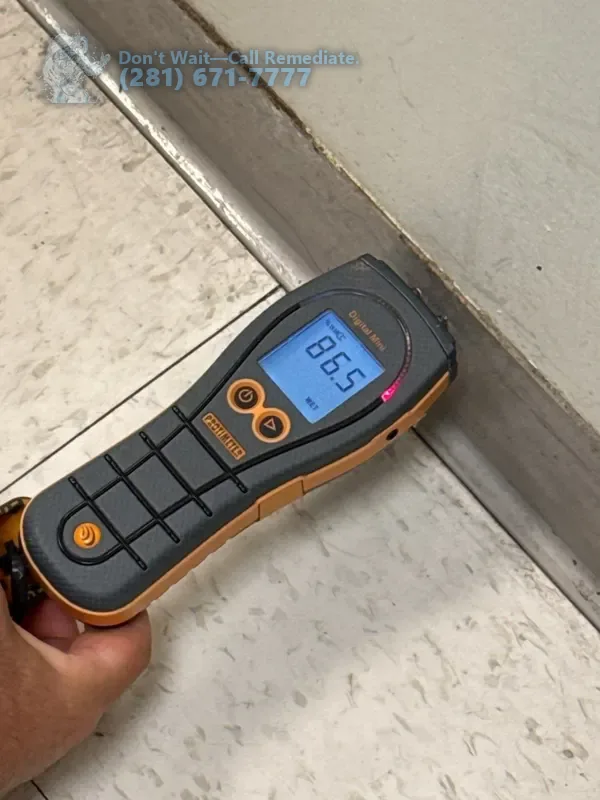
Two kinds of number come up on this meter. Pressed flat on the carpet, it gives a relative number, marked REL on the screen. With the pins pushed in, it reads between the two points, marked %WME. The two do not compare with each other, so a job is followed like with like: the same material, the same mode, day after day.
How fast did the floor dry?
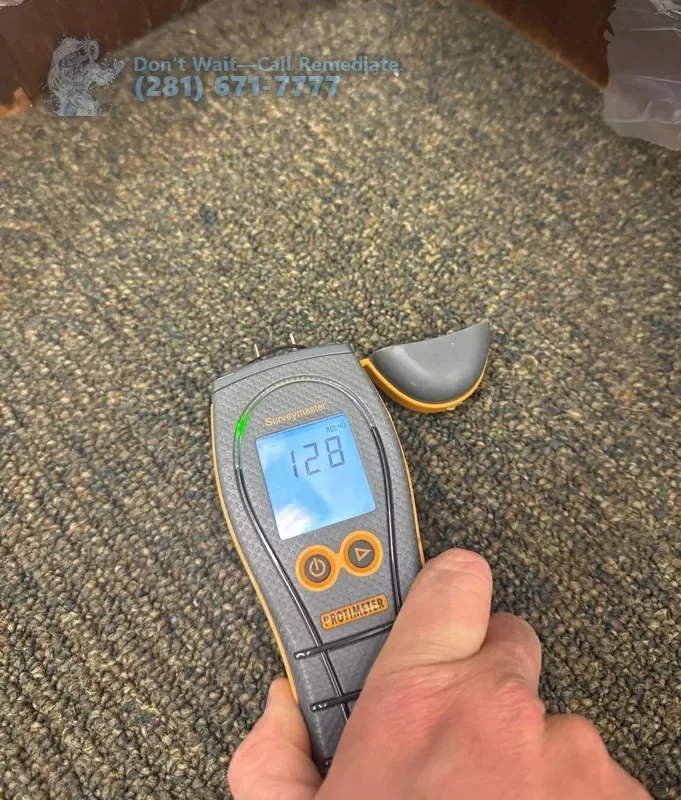
The shelves were wrapped in plastic, and air movers and dehumidifiers ran on the floor. On April 17 the brown carpet on the sales floor still read 354, WET. The next morning, at 11:05 on April 18, three spots on the green carpet read 142, 128 and 151, and the meter's light was green. Not quite three days after the first reading.
Why was the wall still wet?
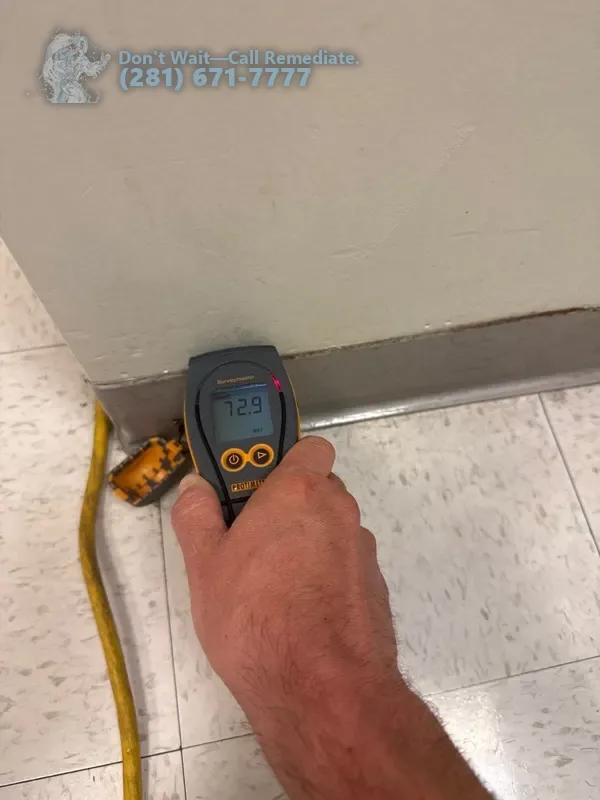
Four minutes later, in the staff room, the wall above the base read 72.9. WET. On April 17 another point on the wall line had read 99.9, the top of the scale.
This is the part people miss. An air mover dries what the air can reach. Carpet lies open to it. A wall is two sheets with a closed space between them, and here that space held insulation. Water that gets under the base sits on the bottom track, soaks up into the paper on the back of the drywall, and the fan in the room never touches it. The paint can look perfect the whole time.
This wall also sat on metal studs and a metal track on the slab. Industrial hygienists writing in AIHA's The Synergist note that wicking is likely to happen faster with metal framing, because wood-framed drywall usually hangs about half an inch off the floor. A long-time restoration contractor and trainer, writing in Restoration & Remediation, lists metal framing on a concrete slab among the reasons to take a wall out rather than dry it.
What was behind it?
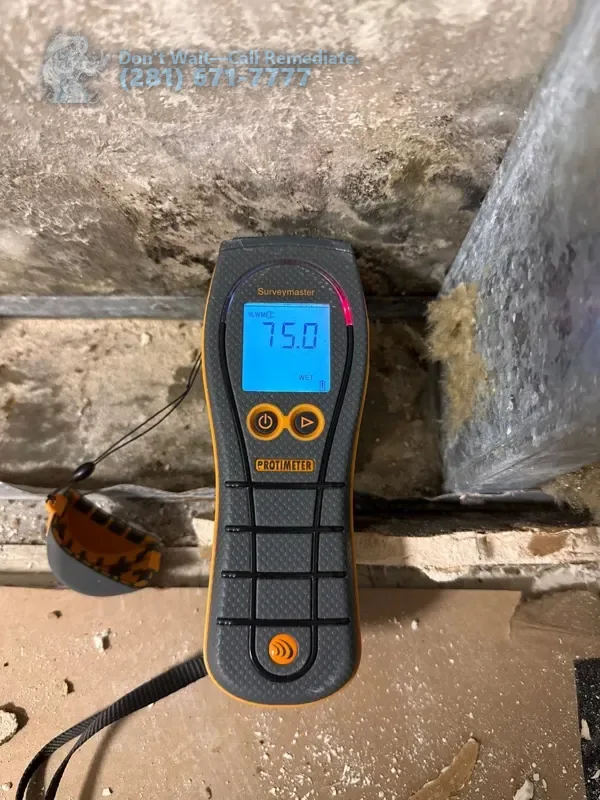
On April 25 the bottom of the walls was opened. The back of the drywall and the bottom of the wall were dark with mold. Inside the wall the meter read 75.0 and, a step away, 63.5. Ten days after the water, the inside of that wall was still wet.
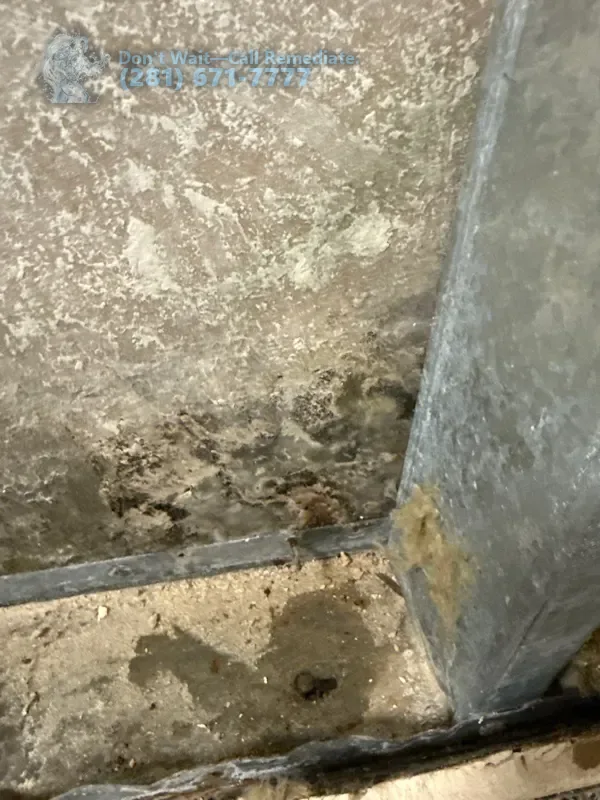
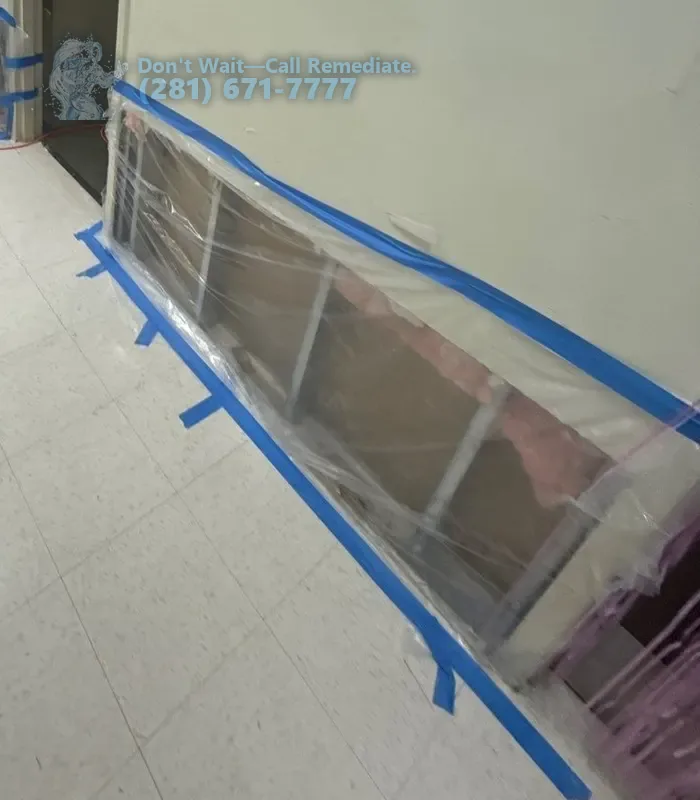
By April 28 the bottom of the walls had been cut out around the staff room and the openings were sealed with plastic and tape while the work went on. Our rule after mold has no exceptions: everything the mold touched is replaced with new material, never cleaned and reused.
So when can wet drywall stay?
The EPA's table for the first 24 to 48 hours, written for clean water, says wallboard may be dried in place if there is no obvious swelling and the seams are intact; if not, remove it, discard it and replace it. It also says to ventilate the wall cavity if possible. Once mold has grown, or the material has been wet for more than 48 hours, the EPA sends you to its mold table instead.
On a job, that comes down to five questions:
- What kind of water was it? A clean supply line is one thing. Drain water or water from outside is another, and the wall is not a candidate for drying.
- How long has it been? Count from when the water came, not from when you saw it.
- Is the wall soft, swollen or open at the seams? Then it comes out.
- What does a dry wall read? The number that means dry is the reading of the same material in a part of the building the water never reached, taken with the same meter in the same mode. That is the target, written down on the first day.
- Is the reading falling? A wall that is drying shows it, day after day, at the same spot. A wall that stops falling while the rest of the room is dry is holding water where the air can't reach.
How high does the wall get cut?
Above the wet, not above the stain. In an EPA test cited by the same AIHA article, the line you could see on the drywall reached about three inches after two days in half an inch of water, while the moisture itself reached nearly thirteen. The cut follows the meter, reading upward until the wall reads like the dry wall elsewhere.
Not every wet wall has to be cut. A closed wall can sometimes be dried by drilling small holes low in the wall, behind where the baseboard sits, and pushing dry air into the cavity, so the repair hides under the baseboard. The Restoration & Remediation article calls this a tool that is not the right choice for every job. It does not fix a wall that already has mold in it.
What should you do while you wait for us?
Shut the water off if you can reach the valve safely, and stay away from wet outlets. Pull furniture and boxes off the walls so air can move along the base. Don't pull the baseboard yourself if you see or smell mold: opening a moldy wall without closing the area off spreads it. Take photos of every wet wall before anything is moved.
If you already have fans running, ask whoever set them one question: what did the wall read today, at the same spot as yesterday? If nobody can answer, the wall has not been checked.
If insurance is involved
Those dated readings are the record. They show when the carpet was dry, when the wall was not, and why the wall was opened. We document the loss with photos, moisture readings and line-item estimates in the industry's standard estimating format, and send them to the adjuster. Coverage stays between you and your insurer. More is on how we work with your insurance company.
Questions about wet drywall
Can I tell by touch if drywall is dry?
No. On this job the painted face looked normal while the meter read 72.9 at the base. The back of the sheet and the space behind it are what you need to know about, and only a reading or an opening shows that.
Will fans in the room dry the inside of a wall?
Often not. Fans dry surfaces the air reaches. A closed wall with insulation in it has to be ventilated or opened. Here the carpet passed in about three days with machines running, and the inside of the wall was still wet on day ten.
If there is mold behind the drywall, can it be cleaned and kept?
Not on our jobs. Everything the mold touched is replaced with new material, never cleaned and reused.
Sources
- Our own job: a Bay Area store, April 15 to 28, 2025; readings and times from our photos.
- Newcomer, Johnston, Mareedu-Boada, Rose and Seward, Looking Beyond the Barrier, AIHA The Synergist, February 2024: metal framing and wicking, the EPA wicking test, cutting above the moisture gradient, a dry standard from unaffected material.
- Darren Foote, Dry or Demolish? Navigating the Complexities of Wall Cavity Restoration, Restoration & Remediation, April 22, 2025: reasons to remove or dry in place, cavity drying through holes behind the baseboard.
- EPA, Mold Remediation in Schools and Commercial Buildings, chapter 4, Table 1 (updated September 8, 2026): wallboard, the wall cavity, and the 48-hour line.