 Remediate RenovationBay Area and Dallas–Fort Worth · 24/7, a person answers
(281) 671-7777

Don't Wait—Call Remediate.
Mold inspection and testing
Remediate Renovation does mold inspections in the San Francisco Bay Area; in Dallas–Fort Worth an independent licensed mold assessor does the assessment and we do the remediation, and a person answers 24/7 for both. A smell, a stain or an old leak you are not sure about. We find where the moisture is, show you what we see and tell you what it would take.
- Insured
- A person answers 24/7
- Moisture readings and photos, not guesses
- Free consultation and quote
Finding, not removing
Why an inspection comes before any tear-out
You cannot see most of it
Mold tends to start where water sat out of sight: inside a wall, under a floor, at the back of a sink cabinet. What shows in the room is often only the edge of it.
The water is the real clue
Mold needs moisture to grow. So the first question is not "is there mold" but "where is it wet, and why". A meter answers that through paint, tile and wood.
What you get back
A clear picture before anyone opens a wall: where the moisture is, what is showing, and how far the work would have to go.
No pressure to book the removal
The inspection is its own visit. You decide afterwards whether anything needs to come out, and who does it.
What we look at
What a mold inspection with us covers
We go where water hides in a house, room by room, starting from whatever made you call.
The spot you noticed
The smell, the stain, the soft floor or the bubbling paint. We start there and work outwards.
Wet rooms and their walls
Bathrooms, kitchens and laundry areas, and the floors and walls that share a side with them.
Under and behind fixtures
Sink cabinets, the space behind the dishwasher and washer, the base of the tub and toilet.
Old leaks
Any place that leaked before, even if it was fixed and painted over. Tell us about it on the call.
Readings and photos
Moisture readings on each surface we check, and photos of what we see, so the findings are on record.
Lab samples
Ask us on the call whether your visit includes samples for a lab.
A real job in Fremont, 2026
A floor that looked dry, and what the meter said
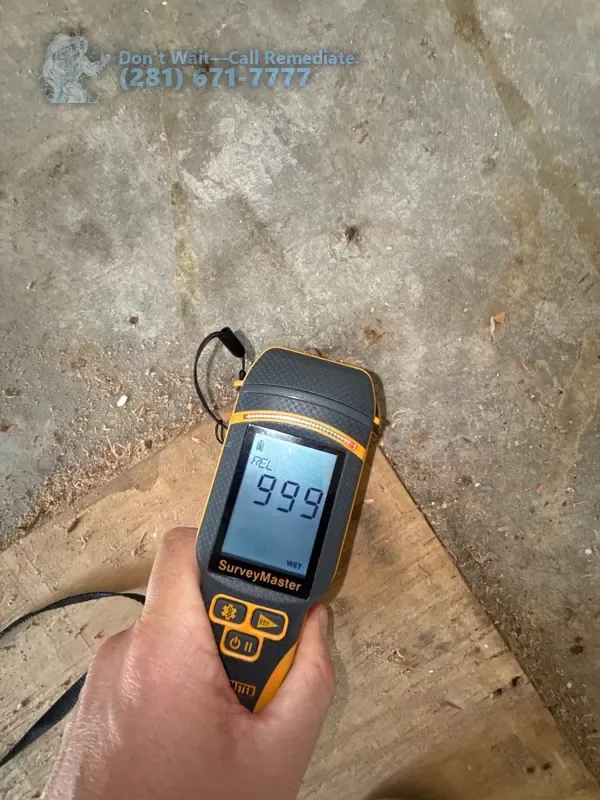
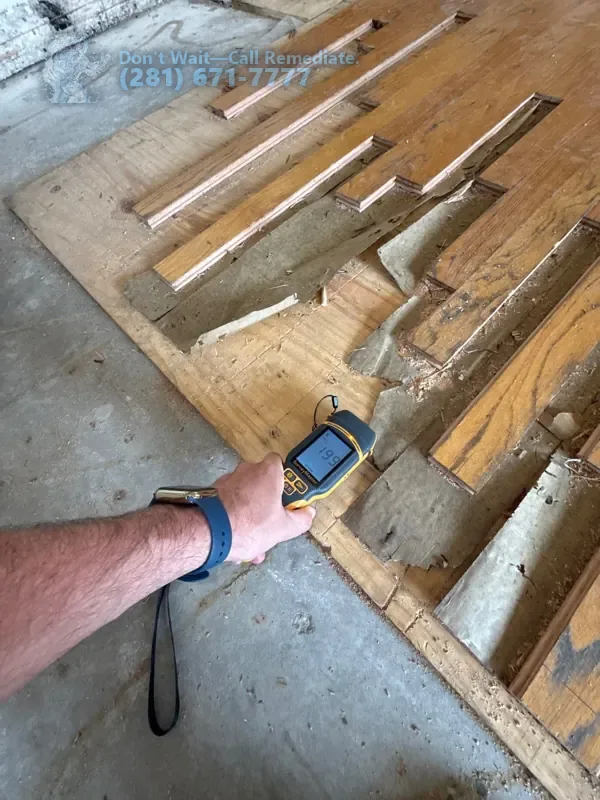
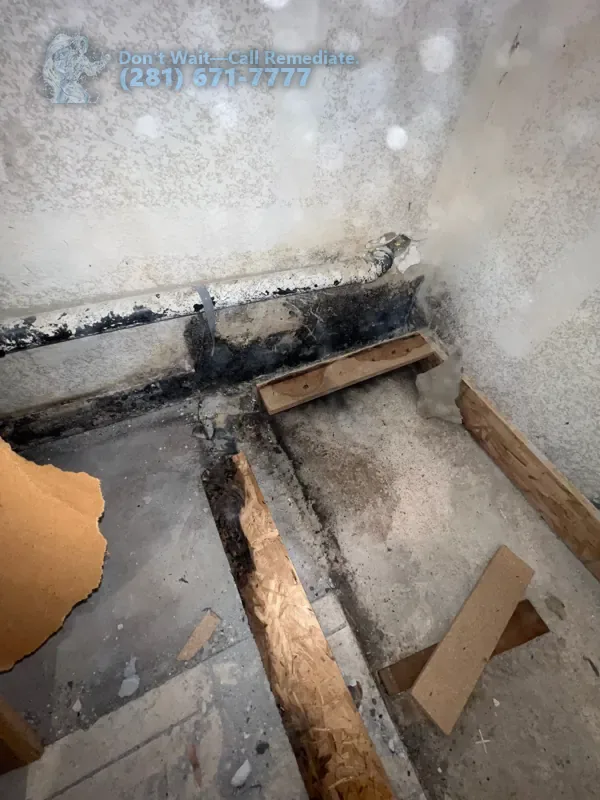
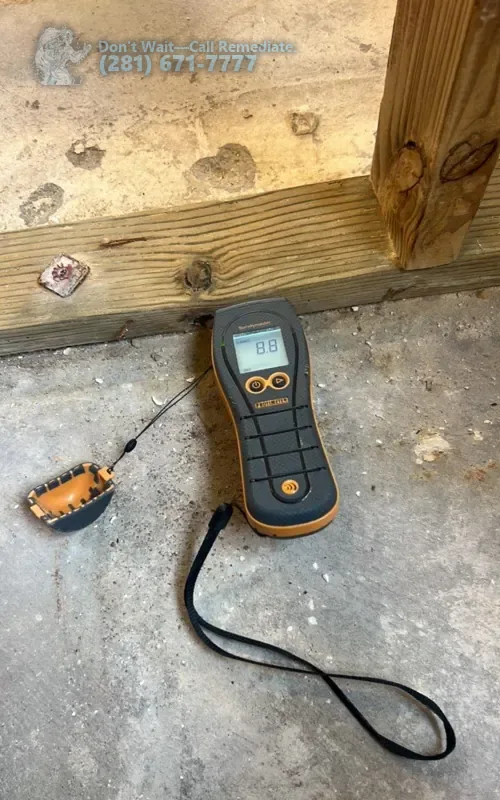
From above, the hardwood looked fine. The first reading on the subfloor hit the top of the meter's scale. Lifting the boards showed why, and the mold along the wall was only found once the floor came up.
All 4 photos, one by one
How it goes
From your call to the findings
You tell us what you noticed
What you see or smell, which room, and whether anything has leaked there. The phone is answered 24/7.
We set the visit
We agree a time with you.
We read and photograph
Moisture readings across the area and the rooms around it, and photos of everything we find.
We go through it with you
Where it is wet, where mold is showing, what caused it if we can tell, and what would have to come out.
The first consultation and quote are free.
Why people call
The usual reasons for a mold inspection
A musty smell
Strongest in one room or one cabinet, with nothing to see. The smell is a reason to look for water nearby.
A stain or spots
On a ceiling under a bathroom, on a wall behind the washer, along a baseboard. We check how far the moisture goes past what shows.
After a leak
A pipe, a dishwasher or a roof leaked and was fixed. You want to know whether the wall or floor under it dried out.
Dallas–Fort Worth
Texas keeps the assessor and the remover apart
Two licensees, one project
Texas Occupations Code 1958.155 does not let the same licensee assess and remediate one project. The person who writes up the mold is not the person paid to take it out.
What that means with us
On a Texas project we remediate, the assessment is done by an independent licensed mold assessor. We never assess and remediate the same Texas project.
In the Bay Area
We inspect, and if you go ahead, the removal follows as mold remediation with the same team, so you do not have to explain the house twice.
Cost and planning
What changes an inspection
How much of the house
One bathroom wall is a short visit. A smell that moves around the house, or several old leaks, means more rooms to read.
Price
Ask for the price before the visit, and we tell you.
Insurance
Whether a policy pays is between you and your insurer. Our readings and photos are written so an adjuster can use them. See how we work with your insurance company.
The first consultation and quote are free. Our work comes with a written warranty, its terms set in your contract, and financing is available through our lending partner.
What can follow an inspection
- Mold remediationThe removal: everything the mold touched is replaced with new material, never cleaned and reused.
- Water damage mitigationDrying the water the inspection found, measured until the readings say dry.
- The Fremont jobHidden water under a hardwood floor, from the first reading to the new floor.
Where we do mold inspections
We inspect for mold in the San Francisco Bay Area. In Dallas–Fort Worth, the mold assessment on a project we remediate is done by an independent licensed mold assessor, and we do the remediation and the rebuild that follows. See the cities we serve.
Questions
What people ask before a mold inspection
What is the difference between a mold inspection and mold remediation?
An inspection finds things out: where the moisture is, where mold is showing, and what the water came from. Remediation is the removal that follows, when everything the mold touched comes out and is replaced with new material. You can book the inspection on its own and decide afterwards.
It smells musty but I cannot see any mold. Is an inspection worth it?
A smell with nothing to see is a common reason people call. Mold needs water, so we look for the water first, with a moisture meter on the floors, walls and cabinets near the smell. On our Fremont job the floor looked dry from above; the meter showed water under it, and the mold was only found once the boards came up.
What do you check during a mold inspection?
The places water collects without being seen: under sinks and appliances, behind and under cabinets, along floors next to bathrooms and kitchens, and around any past leak. We take moisture readings, photograph what we see and ask about anything that has leaked before.
In Texas, can the company that inspects for mold also remove it?
Not on the same project. Texas Occupations Code 1958.155 keeps the mold assessment and the mold remediation of one project with separate licensees. On a Texas project we remediate, the assessment is done by an independent licensed mold assessor, and we never assess and remediate the same Texas project.
What do I get when the inspection is done?
Our photos and moisture readings, and a plain account of what we found: where it is wet, where mold is showing, and what would have to come out if you go ahead. If there is a claim, the same documentation goes to your adjuster.
Will my insurance pay for a mold inspection?
That depends on your policy and on what caused the water, and the decision is your insurer's. What we do is document the loss for the claim: photos, moisture readings, and line-item estimates in the industry's standard estimating format.
Don't Wait—Call Remediate.
Book a mold inspection
Tell us what you noticed and in which room. We call you back to set the visit.
Call (281) 671-7777